

Schumpeter Digest #72

Frontier Knowledge. Breakthrough Innovation. Competitive Advantage.
Schumpeter is an applied intelligence platform that transforms cutting-edge scientific and technological research into structured, actionable insights for business and investment strategy. It systematically analyses peer-reviewed publications and emerging technologies, translating them into standardized profiles that explain how each innovation works, why it matters, and where it can be applied in practice. Each profile follows a consistent analytical framework based on recognized indicators such as Technology Readiness Level (TRL) and sectoral classification, ensuring comparability and operational relevance.
By bridging the gap between academic discovery and market adoption, Schumpeter enables decision-makers to anticipate technological disruption and identify opportunities for innovation and partnership. Entrepreneurs gain validated ideas for new ventures; investors access early awareness of technologies with commercial potential; and companies strengthen their innovation strategies through clear, evidence-based intelligence.
All profiles feed into a continuously expanding database that maps the global landscape of emerging technologies. Subscribers gain full access to this knowledge infrastructure, allowing them to explore real-world applications, benchmark technological trends, and translate scientific advances into competitive advantage.
Solar-Powered Photoelectrocatalysis: A Sustainable Route for Clean Water and Micropollutant Removal
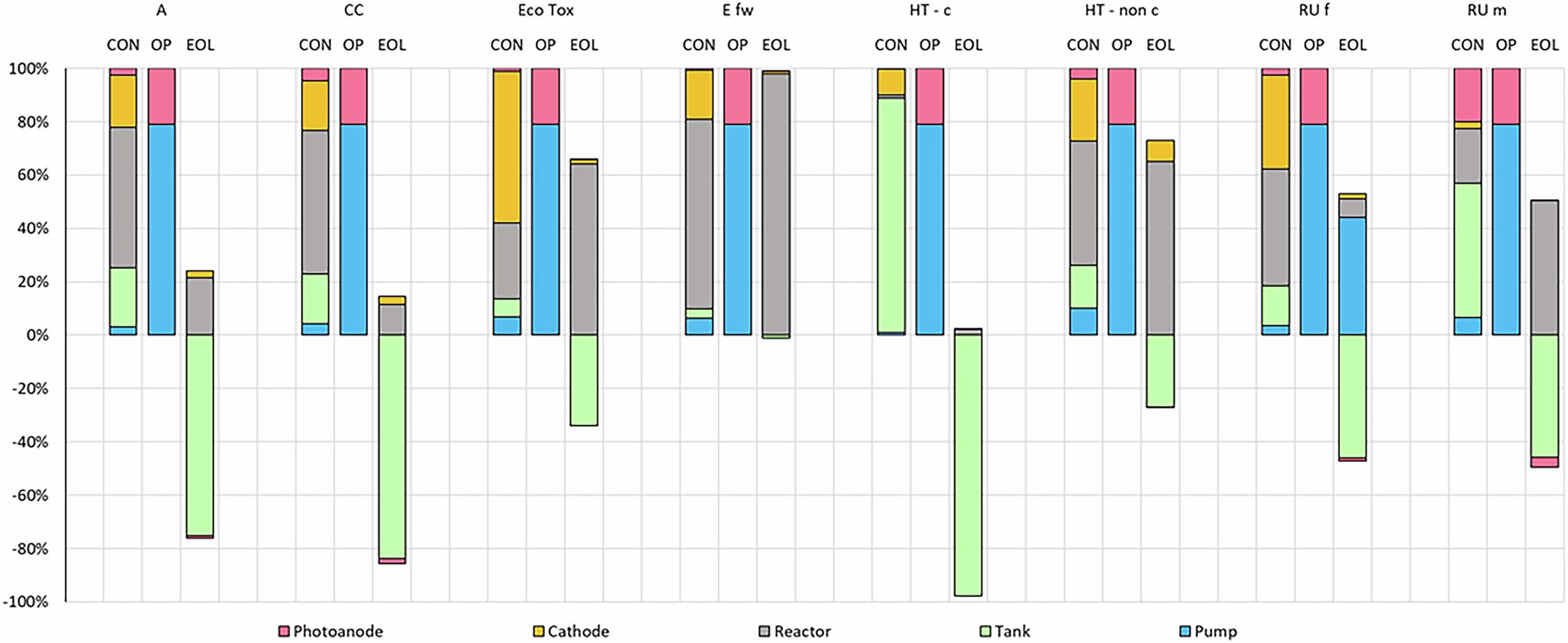
A team of researchers from University College London and Delft University of Technology has developed a large-scale model for an advanced wastewater treatment technology that uses sunlight to remove persistent micropollutants. The process, known as photoelectrocatalytic (PEC) oxidation, employs a specially engineered photoanode made of bismuth vanadate (BiVO₄) and titanium dioxide–graphene oxide (TiO₂–GO) to generate powerful oxidants capable of degrading pharmaceuticals, personal care products, and industrial residues that traditional treatments cannot eliminate. A detailed life cycle assessment (LCA) compared the environmental performance of this solar-driven PEC system with that of a full-scale ozonation plant in the Netherlands. The results showed that the PEC reactor achieved superior sustainability, with lower emissions, reduced fossil resource use, and significant energy savings when powered by solar electricity. Although aluminum and glass components increased impacts during construction, these were offset by recycling benefits and renewable energy inputs during operation. The analysis demonstrates that solar PEC oxidation can achieve high removal efficiencies for multiple contaminants while lowering environmental burdens, marking a key advancement toward energy-efficient and regulation-compliant wastewater purification systems.
Optimizing Energy in Collaborative Robots: How Artificial Intelligence Makes Manufacturing More Sustainable
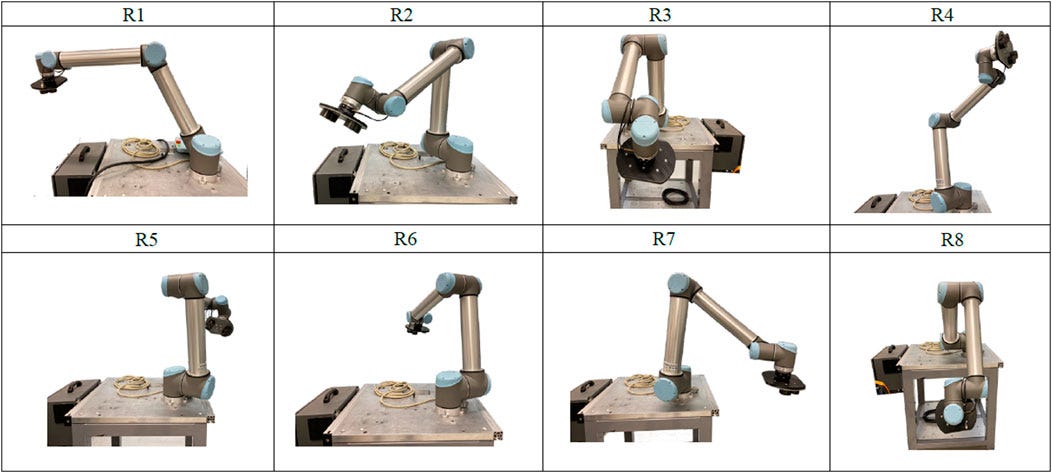
A research team from Tecnológico de Monterrey and Aumovio in Mexico has developed an artificial intelligence-based framework to make collaborative robots, or “cobots,” significantly more energy efficient. Cobots are increasingly common in modern manufacturing because they can safely share workspace with humans and adapt quickly to changing production needs. However, their widespread use raises concerns about energy demand and peak power loads, which directly affect operational costs and sustainability targets. This study analyzed the energy consumption of the popular UR10 cobot by measuring its performance across 1,450 real motion trajectories under different speeds, accelerations, and payloads. The researchers used these data to train artificial neural networks capable of predicting energy use and peak power with over 98% accuracy. They then combined these predictive models with a genetic optimization algorithm to automatically find the motion parameters that minimize energy consumption while respecting power constraints. The results demonstrate that faster, well-optimized movements consume less total energy despite generating higher instantaneous power peaks. This counterintuitive insight opens new possibilities for designing intelligent manufacturing systems that balance productivity, cost, and sustainability.
Ultralight Flexible Fingertip Sensor for Human-Like Robotic Touch
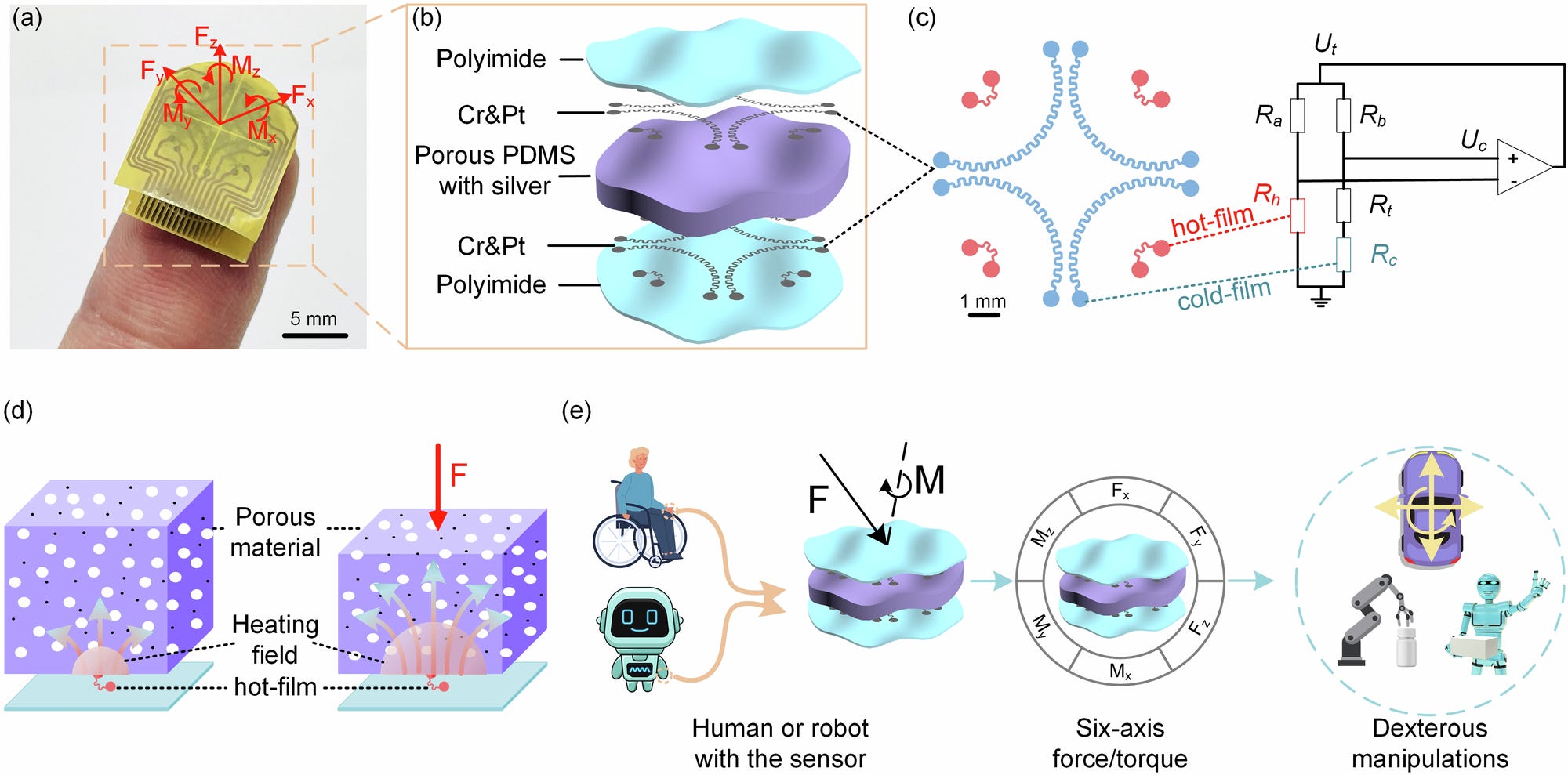
A research team from Tsinghua University has developed an ultralight and flexible six-axis force and torque sensor that brings human-level tactile sensitivity to robots and assistive devices. The sensor, weighing only 0.3 grams and roughly the size of a fingertip, can detect six components of mechanical interaction — three forces and three torques — with remarkable precision. It achieves this through a novel piezo-thermic material that converts mechanical strain into changes in thermal conductivity, captured by microscopic thermistors printed on a flexible substrate. This approach combines mechanical elasticity, electrical sensitivity, and thermal coupling in one low-cost, scalable design. When attached to a robotic fingertip or wearable interface, it enables dexterous manipulation of objects, fine control tasks, and intuitive human-machine interaction. The breakthrough demonstrates that tactile intelligence can be achieved without bulky or expensive instrumentation, opening a pathway for prosthetics, collaborative robots, and remote-controlled systems that “feel” with near-human resolution. The innovation provides a building block for the next generation of robotic and assistive technologies designed for delicate, precise, and responsive touch-based control.
High-Sensitivity Flexible Pressure Sensor for Next-Generation Robotics and Wearables
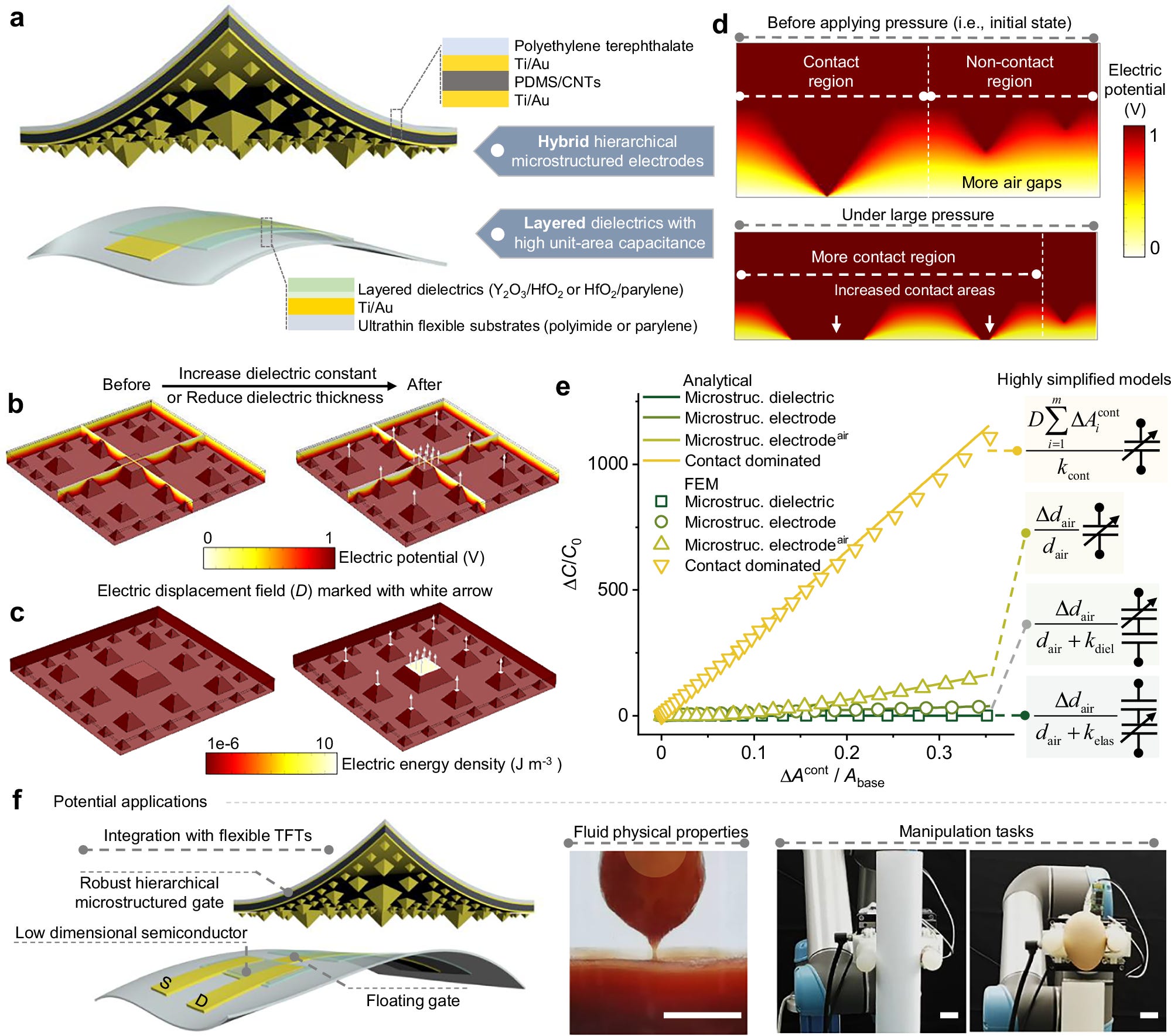
Researchers at Peking University have developed a new class of high-sensitivity flexible pressure sensors based on a “contact-dominated localized electric-displacement-field-enhanced” design. This innovation represents a major advance in tactile sensing for humanoid robots, prosthetics, and intelligent wearables. Traditional capacitive pressure sensors offer stability and low energy consumption but suffer from limited sensitivity and nonlinearity. The new design overcomes these constraints by combining hierarchical microstructured electrodes with layered dielectrics that amplify the electric displacement field at contact points. This allows the sensor to achieve an exceptionally high pressure response—over 3000 times its baseline capacitance—and operate reliably across pressures exceeding one megapascal. The resulting linear response, high sensitivity (9.22 kPa⁻¹), and low operating voltage make it suitable for precise force feedback, robotic control, and biomedical applications. Integrated with thin-film transistors, the sensor converts pressure variations into electrical signals with amplification ratios above 10⁵, enabling real-time feedback in robotic manipulation and fluid monitoring. Its robustness, low cost, and scalability make it a key enabling technology for intelligent tactile systems in robotics, healthcare, and smart environments.
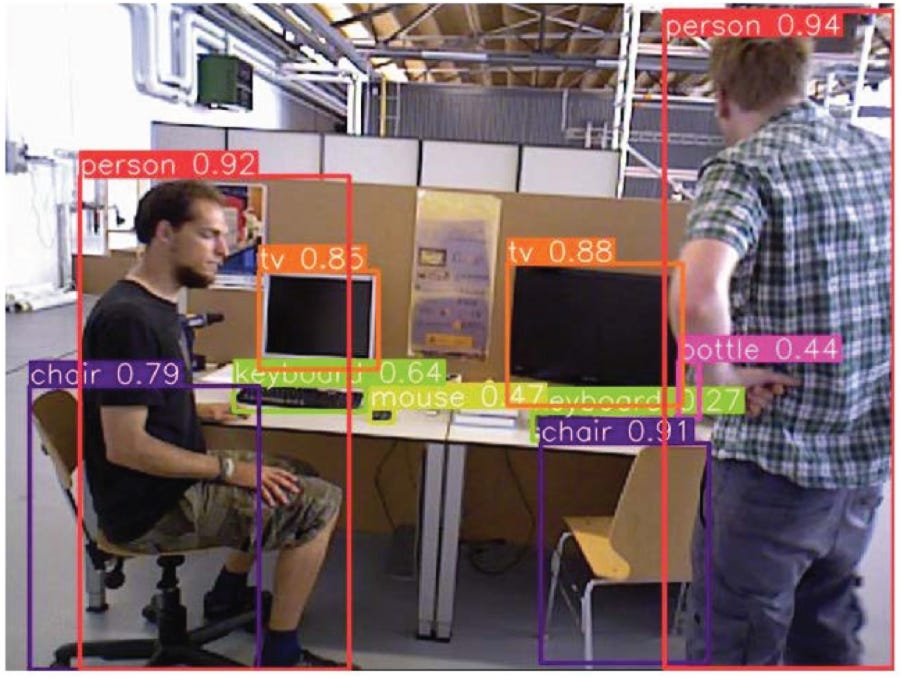
Enhanced Visual Navigation for Dynamic Environments: The 2HR-Net VSLAM System
A research team led by Wang Yang and colleagues has developed an advanced visual simultaneous localization and mapping (VSLAM) framework called 2HR-Net, designed to improve the performance of autonomous robots operating in complex and dynamic environments. Traditional visual SLAM systems, such as ORB-SLAM3, struggle to maintain localization accuracy when moving objects distort visual references. The proposed 2HR-Net system addresses this challenge through an innovative combination of feature extraction, deep learning, and object recognition. By introducing a High-Reliability and High-Repeatability feature detection network (2HR) integrated with YOLOv8n object detection and a shared Siamese matching architecture, the system achieves more robust and precise localization even in scenes filled with motion. Tested on the benchmark TUM dataset, 2HR-Net reduced trajectory error by up to 90% compared with conventional approaches. It demonstrated superior feature repeatability and robustness while maintaining real-time performance without specialized hardware. This breakthrough enhances the ability of mobile robots, drones, and autonomous vehicles to navigate dynamically changing environments with greater reliability, paving the way toward safer, more adaptive, and intelligent autonomous systems.
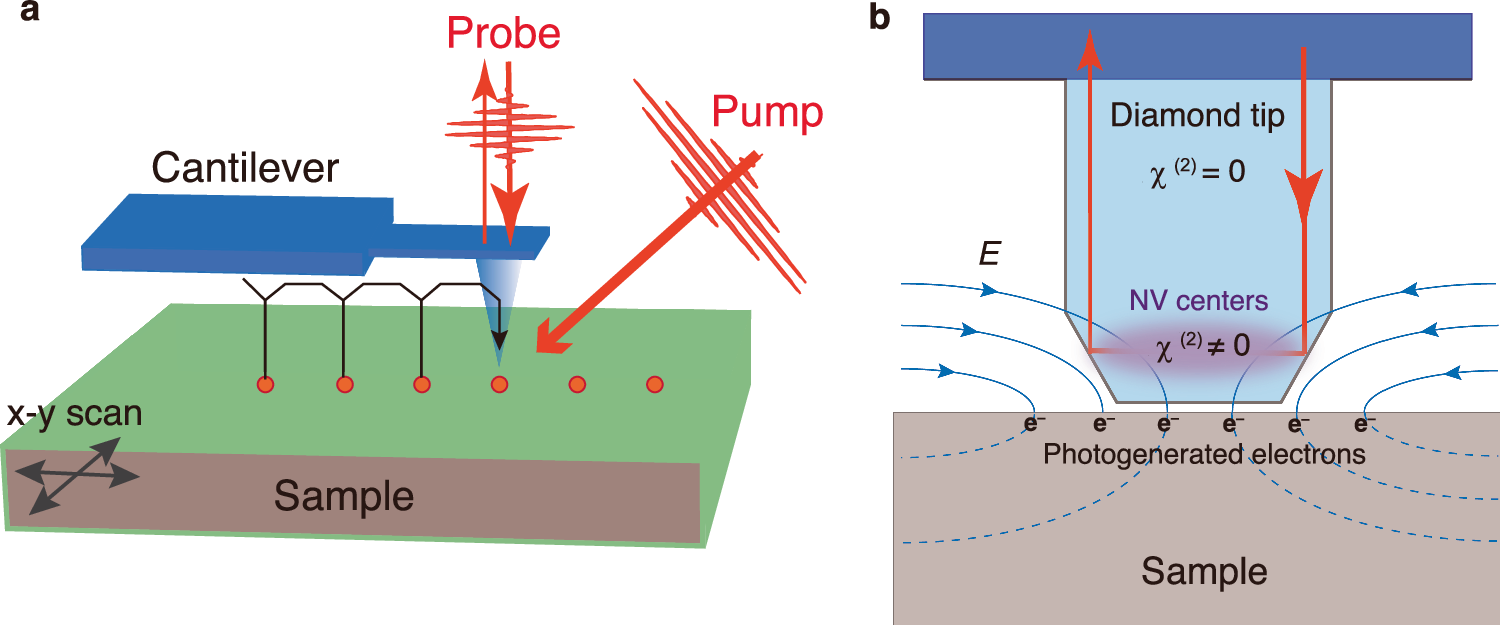
Ultrafast Diamond Nonlinear Photonic Sensor for Quantum-Scale Electric Field Detection
Researchers from the University of Tsukuba have developed an ultrafast nonlinear photonic sensor based on nitrogen-vacancy (NV) centers in diamond, capable of detecting electric fields at the nanometer–femtosecond scale. This breakthrough merges ultrafast optics, quantum sensing, and nanofabrication to overcome the spatial and temporal limitations of traditional electro-optic sensors. Conventional electric-field sensing relies on the Pockels effect in nonlinear crystals, which provides picosecond time resolution but limited spatial precision. The new sensor exploits NV defects within a diamond nanotip that break inversion symmetry, enabling a second-order nonlinear optical response and allowing direct measurement of surface electric fields without metallic contacts. Using 10-femtosecond near-infrared laser pulses, the system can resolve carrier dynamics in two-dimensional semiconductors with spatial resolutions below 500 nanometers and temporal resolutions below 100 femtoseconds. Tested on gallium arsenide and tungsten diselenide surfaces, the sensor mapped local electric field variations and ultrafast charge dynamics previously beyond the reach of existing techniques. This innovation opens new opportunities for characterizing materials, quantum devices, and nanoscale electronic phenomena with unprecedented precision and speed.