
Computing Textiles Without Chips
A single fibre integrates reconfigurable diode and memristor functions via electrochemical interface control

Executive Summary
Modern wearable systems face a structural constraint that is not primarily a matter of sensors or connectivity, but of architecture. Most electronic textiles still depend on rigid silicon-based integrated circuits for computation and memory. This creates a fundamental mismatch between the mechanical properties of soft fabrics and the stiffness of electronic components, which affects comfort, durability, and the ability to integrate computation seamlessly into garments.
This mismatch is not marginal. Textile materials typically operate within a range of flexibility and curvature that is incompatible with conventional chips, making it difficult to embed computation invisibly within clothing. As a result, most wearable systems remain hybrid systems in which textiles act as interfaces, while actual processing is external or rigidly embedded.
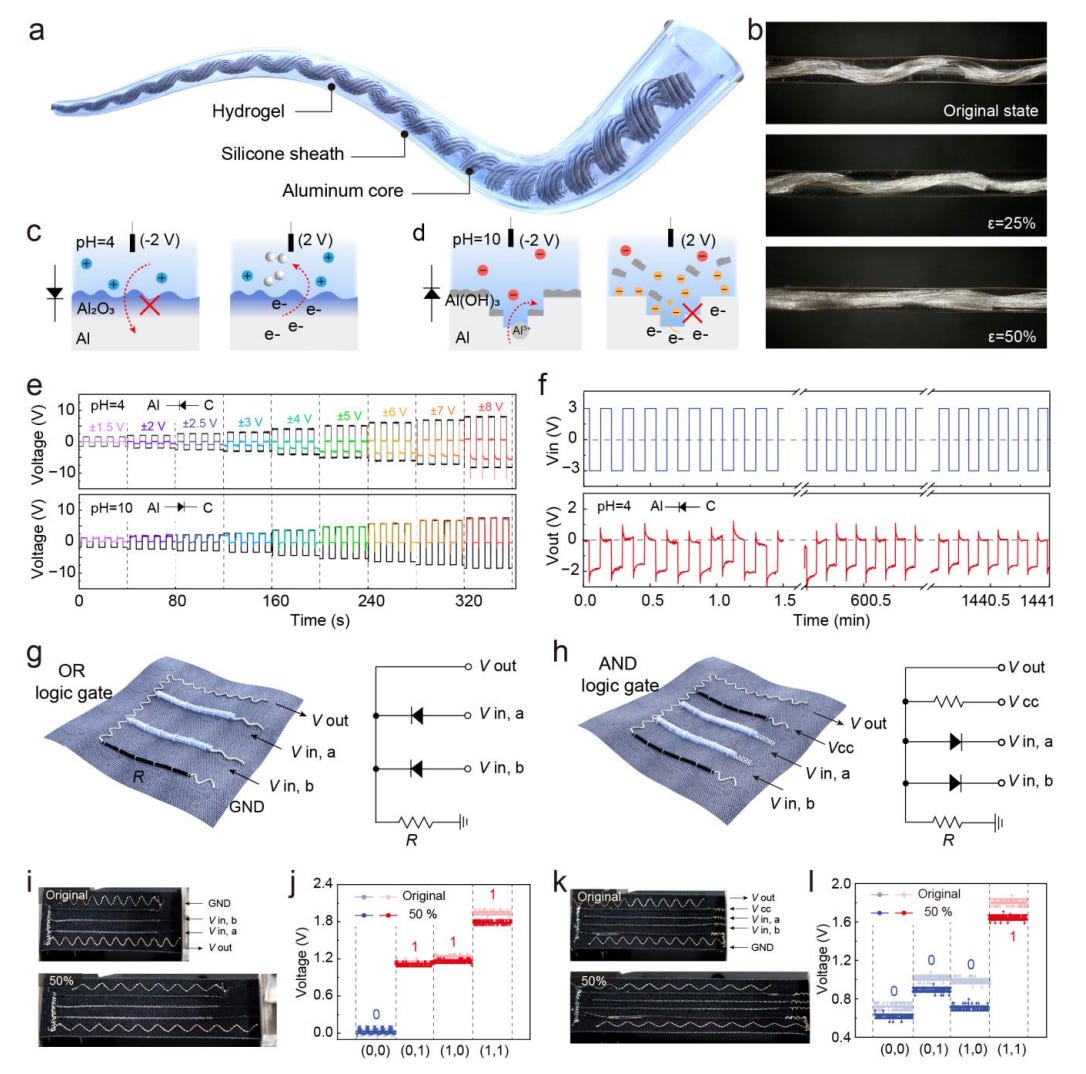
The research introduces a different approach. Instead of attaching computation to textiles, it embeds logic and memory directly within a single fibre. The same fibre can be configured to behave either as a diode, which controls current direction, or as a memristor, which retains a memory of electrical states. This transforms the fibre from a passive structural element into an active computational unit, enabling the possibility of distributed computation within fabrics.